
Boys in the Boat
Posted on August 24, 2013 2 Comments
Sipping a tall glass of Czech Republic pilsner in a Prague cafe the other evening, I began to notice how extraordinarily smooth the glass felt in my hand. I turned it around and examined it more closely, when suddenly it dawned on me: It wasn’t the glass that was smooth — it was my hand. Setting the beer aside, I held up both of my palms for inspection. Yes, it was true. Nearly all of my rowing calluses had vanished.
Traveling inland through Europe the past 10 days, I’d been off the water all that time and now retained hardly any evidence whatsoever of having rowed in six races in the recent World Masters Games in Italy. Or having rowed almost daily in the early summer (in preparation for the Games) on my hometown lake in Alaska. Or for that matter training all winter long on indoor rowing machines with my Anchorage crew mates.
Had my memory of the Games vanished as well?
I sat there and tried to recall my races, one by one. There was my single-scull heat on Day 1 (in close to 100-degree heat). Rowing on a straight-arrow 1,000-meter course, I came in fifth out of seven, beating out a portly Australian and a dead-last Italian — but failing to keep pace with the top three scullers from Russia, Poland and Germany, a kind of Eastern Bloc sweep.
To tell the truth, I didn’t so much mind losing my heat to three clearly superior, more experienced scullers. I felt afterward that I’d rowed hard and well and that’s what mattered to me most. Afterward I saw that my time was actually about 30 seconds faster than it was in the last World Masters Games four years earlier in Sydney. And now, I told myself, if I could just shave off a mere half-minute more in the next four years, I might stand a chance to medal in Auckland. (Such is the not-necessarily rational post-race optimism of rowers.)
Three other male teammates rowed in singles heats as well, each in younger (and faster) age divisions than mine. All three rowed well, but suffered a variety of hard-luck stories. Two of our best scullers (Scott Coon and Dan Brokaw) had the misfortune of being placed in the fastest heats and failed to advance by a hair. Mike Chriss actually won his heat — but then got administered out of rowing in the final by a spider’s web of Italian organizational scheduling conflicts with two other races he was rowing.
For the men, our collective luck didn’t get any better on Day 2, when our sweep-oared men’s eight failed to advance to the finals, finishing a disappointing fifth. There was really no excuse we could point to. We’d rowed hard and were driven hard by our coxswain Natasha Graham. We simply got beat by better crews. Which isn’t all that surprising, considering how much the Games have grown.
A word about that. Something like 18,000 athletes competed in Torino this month in 30 different sports (far more than competed in the last Olympics). In rowing alone there were 1,200 competitors. Our small happy band from Alaska numbered about two dozen women and one dozen men. We were told we made up the largest contingent of rowers from any single state in America. But at the same time we were totally eclipsed by an estimated 700 rowers from Australia.
A day before the Games were to begin, one of them told me that about half of the Australian rowers were there just for the experience and the fun of visiting Europe. “That’s me,” she said. “The other half, though — they’re serious. They want to medal. They’ve been training the last month in camps…”
Those fairly daunting odds of 20 Australians for each Alaskan prevailed in all the other men’s races as well, as our boats either failed to advance to the finals or failed to medal if they did. All of which makes the accomplishment of the Alaskan women (see previous post, “Those Alaskan girls”) — medaling in seven races — all that more extraordinary.
On the last day of competition, the guys got to join together with the women in all the “mixed boat” events, and Sue Sheard and I teamed up in a double. But it was touch and go on whether we would even make it to the starting line. First our coach, Kern McGinley, had to plead with Italian race officials to allow us to launch (due to another scheduling conflict, the race was about to start). Then we had to quickly row 1,000 meters from the finish to the start — where everyone else was waiting — execute the equivalent of a swimmer’s lap turn, slip into our lane and start the race virtually without pause. We rowed well, I thought, but finished fourth. And only the winner advanced.
So the last day of the Games was just about to end without any Alaskan male winning a medal. But then Homer rower Jim Hurd took full advantage of his own mixed-boat opportunity by teaming up with his medal-winning wife, Karen, to capture the bronze in their senior doubles race. And on behalf of all the guys, may I say: “Thank you, Jim!”
Siren Songs
Posted on August 18, 2013 Leave a Comment
“Then, for coffee, I pulled up a chair in the smoke-and-coffee-stained Café Hawelka, where intellectuals like Leon Trotsky once stewed. The decor was circa-1900. Old man Hawelka himself was snoozing on a Biedermeier chair near the bar. His granddad could well have served a Mélange (as they would have called their cappuccino) to Trotsky, Hitler, Stalin, Klimt, or Freud — all of whom were rattling around Vienna when the chair I was sitting on was made …”
— American travel writer Rick Steves, from “Sunday Morning, Vienna Style”
Turns out I was rattling around Vienna this past weekend too, my first venture ever into what used to be considered — for about 600 years — the most powerful city in eastern Europe. Hometown of the prolific Habsburg family, rulers of the once-sprawling Austro-Hungarian empire.
Maybe a little bit too sprawling. Over-reach by the Habsburgs into places where men and women had little in common in speech or custom with their Austrian overlords was one of the chief causes of World War I, which ended the Habsburg rule once and for all.
(For the record, though, a more complete answer to the Trivia Game question of who started WWI goes like this: (1) A teenage Serb nationalist in Sarajevo assassinates his future king — a Habsburg — Archduke Franz Ferdinand. (2) One month later Austria declares war on Serbia. (3) A tangled web of international alliances and nationalist ambitions prompts Russia, Germany, France, England and Italy all to join the war, too, on one side or the other.)
In any event, it wasn’t over in a week as advertised and it didn’t go well for anybody. Certainly not the Habsburgs.
I’d never met one until this week, but it’s pretty hard to miss the former Empress Marie-Theresa, sitting there sensibly enough in the center of Maria-Theresien Platz. I liked her immediately. Approaching her statue from behind, I noticed the way she filled the throne from side to side (see slide show below). And from the front, I noticed too that she held in her left hand — just as Wikipedia said she would — a rolled-up copy of the “Pragmatic Sanction of 1713,” which for the very first time gave women the right to rule the empire if their parents failed to produce a male heir (more in the interest of keeping the monarchy in the family than any sort of progressive notion about women’s rights). Well, that triggered another European war right there, one that even spilled over to King George’s America. But the Habsburgs ultimately prevailed, and during her 40-year rule Maria bore 16 children, nearly all of whom she married off to become royalty of the surrounding nations of Europe. Pragmatic indeed!
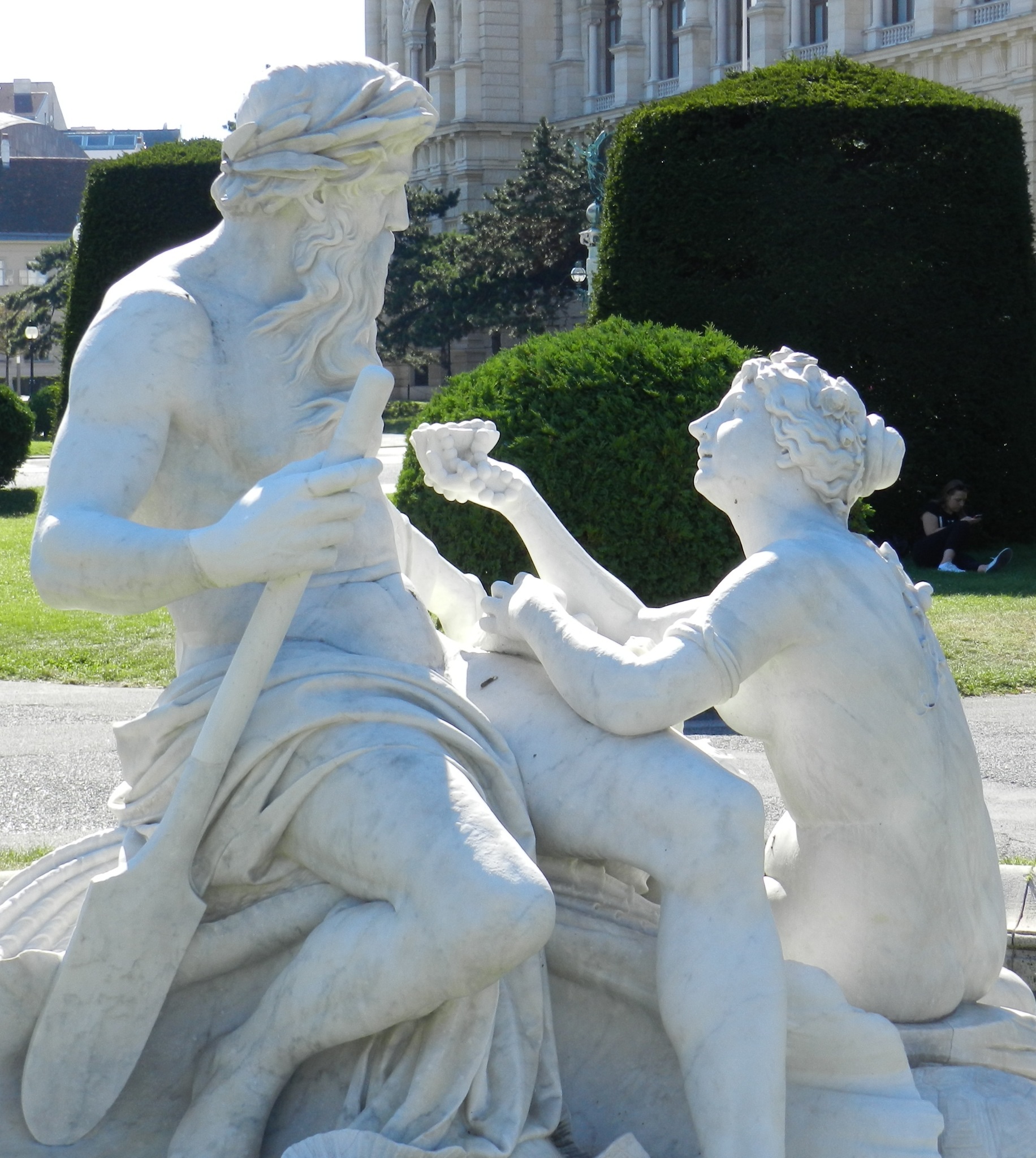
Maria’s statue gazed off in the direction of her family’s estate — a long, curving palace that could have inspired Karl Marx to write Das Kapital had he ever had a chance to visit. But I was gazing off at a fountain, where a nearby classic-Greek statue of a bearded mariner with a short paddle rested in the center of a fountain (see image above).
I tried but could not find any information about who the statue represented or what it celebrated. But I immediately thought: Ulysses! And I think that the sculptor caught him at that very moment in which the goddess Calypso was imploring him to forget about his wife back in Ithaca and remain on her island a while longer.
That kind of thing happened to Ulysses a lot. Something attractive and seemingly easy was always trying to entice him in the wrong direction. Like the song of the Sirens. Or the siren song of war.
I had an opportunity to think about that a little bit more as I left the square and passed by Vienna’s opera house, where the nearby “Monument Against War and Fascism” stands — on the very spot, Steves says, where a couple of hundred people hiding in a cellar during World War II were buried alive when the bombs fell. The statuary there include stark images of the two world wars with an unblinking look at Austria’s role in them. I took some pictures of the monument (again, see the slide show below), but you also might want to learn more about it by following this link: http://www.ricksteves.com/plan/destinations/austria/viennamonument.htm
One last story from Vienna: I was just passing by a monument to a perpetually young Wolfgang Amadeus Mozart when I was approached by a man selling tickets to a concert. That very night, he said, a Konzerte featuring some of the masterworks of Mozart and Johann and Richard Strauss would be performed by the internationally reknown Schoenbrunn Castle Orchestra of Vienna and a wonderful soprano — at the Schoenbrunn Castle, where Mozart himself performed before the king of Austria at something like the age of 5. Would I like to buy a ticket?
Part of me thought: This is my last night in Vienna. I will probably never ever be here again in this lifetime. I should go…. And yet another part of me thought: Wait a second. It’s not cheap. And wouldn’t that be just like the Sirens to find someone vulnerable like me and encourage him in a direction he shouldn’t ought to go? Well, maybe so, I finally concluded. But it wouldn’t be the first time. So I took the ticket as I handed the man some money, then continued on my way.
Good days, bad days
Posted on August 16, 2013 4 Comments
Try as we might to avoid them, mistakes are inevitable — traveling in a foreign land is never problem free. Homer was pretty emphatic on that point (i.e. the day the temptress Circe turned all of Ulysses’ shipmates into pigs, or that singular unpleasantness with the giant one-eyed cannibal…)
Some things just can’t be sugar-coated.

I’m speaking personally now, having just spent an entire night lying on a stone bench in the Zurich train station looking very much like someone who needs to be rousted.
All because I thought I was doing the right thing, boarding a long-distance night train to Vienna a half hour early to make sure I got a decent sleeping berth.
I had my Eurail pass. I had my reservation. I’d paid for the couchette and felt pretty sure I was set to go. I’d just checked the departure board and saw that my train was due to leave Platform 6 in 25 minutes. Glancing in that direction, I saw it sitting there. A train waiting at Platform 6. So I stepped aboard and, within seconds, all the doors slammed shut and the train began to move, leaving the station way early and, as I suddenly realized, going someplace that wasn’t Vienna.
That’s a long way of saying I failed to double-check the destination of the train I’d just boarded. And by the time I’d gotten off at the first stop and taken the first train back to Zurich, the train I should have boarded at Platform 6 (which later moved into place) … had just left.
That’s a bad day — and night.
The previous couple of days, however, were just about as good as it gets, enjoying myself in the stunningly picturesque mountain-top village of Gimmelwald. (See slide show below.)
Gimmelwald is one of those less-visited, not-yet-spoiled destinations that the travel writer Rick Steves recommends, both on his popular NPR radio show and in his book, Europe through the Back Door.
Ever since I said goodbye to all my crew-mates back in Torino, all the other places I’d passed through seemed to me less than perfect. Tunneling through the alpine border from northwest Italy into France, I’d emerged into the daylight of a spectacular valley bordering Mont Blanc (the highest peak in Europe) at Chamonix, which may be the most handsome ski resort I’ve ever seen. But it also had that certain rich jet-set touristy feel that, years ago, contributed toward finally pushing me out of my home in the High Sierra town of Truckee toward Alaska.
After one night in Chamonix, I caught a series of trains that took me to the doorstep of the Swiss Alps at Interlaken. Which was even more touristy than Chamonix and, from my perspective, not as friendly. Interlaken (and in fact nearly all of Switzerland) may well be the stingiest place I’ve ever visited in terms of offering travelers a free wi-fi signal. Which is a real disadvantage for anyone who’s trying to communicate to the outside world through a blog.
Good thing I continued a little further, taking a short train to
Lauterbrunnen, then a bus to Steckelberg, then finally a vertigo-inducing tram up the side of a cliff to Gimmelwald, which I can now report hasn’t lost its charm. I liked everything about it. The friendly Swiss staff at the inexpensive hostel where I’d be staying. The cheerful guests, who seemed to be a pleasant blend of crusty mountaineers and talkative college grads, many of them Americans. The sunny look of the place. The peaks jousting with clouds through my bedside window. The working farms on the hillside. The fantastic network of mountain trails rising in every direction. The great weather, like Alaska on a nice summer day. Real strip off your shirt and go for a hike weather. The post-hike draft beer in the hostel restaurant. The good food. The coffee. The free wi-fi signal that never failed and didn’t even require a password. Yep. I can’t help but think even homesick Ulysses would’ve been willing to stick around.
Raise a glass
Posted on August 14, 2013 Leave a Comment
Climb with us now aboard the bus we chartered to safely transport our rowing team to and from a winery in the hills of northwest Italy. Plus a side-trip to a castle to visit the local nobility.
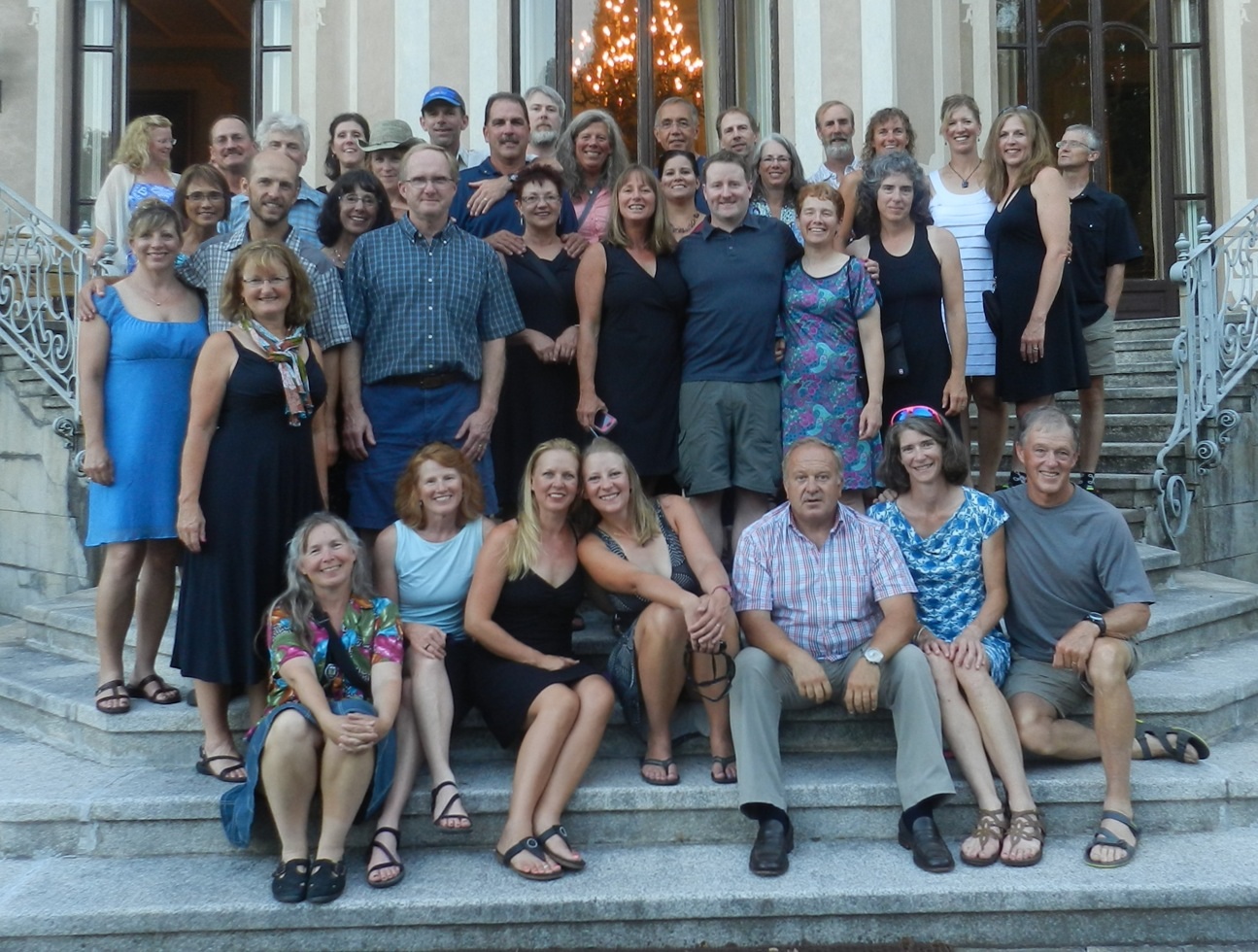
We’re at the World Masters Games in Torino, and it’s the evening of our last day of competition. In the morning all of us will scatter.
Forgive us then if anyone pictured in the slide show posted at the bottom of this dispatch appears abnormally happy.
It’s not the wine so much as the pleasure of our own company. That and a certain pride in having finally crossed the finish line of several 16-hour days and rowing hard and well for a week.
Those Alaskan girls …
Posted on August 14, 2013 Leave a Comment
If I was asked to write a press release, reporting back to media outlets in Alaska exactly what transpired during the four days of rowing events at the just-concluded 2013 World Masters Games in Torino, Italy — as in fact I was — it would look pretty much like the report attached below.
Which is to say it shares the names, numbers and facts about the winners, to the best of my knowledge, in predictable journalistic language. What it doesn’t share, however, are stories about rowers who finished fourth or fifth or last, or how it all felt, or “what the weather was” (as Hemingway used to say) with observations that really matter.
I’ll try to provide some of that when I return to the Games in future posts as I continue my travels across Europe (so maybe you should follow my blog). In the meantime, however, take a look at the pictures in the slide show below the text, which offer a hint of what I’m talking about. Each is its very own story.
Alaska women row to World Masters Games success
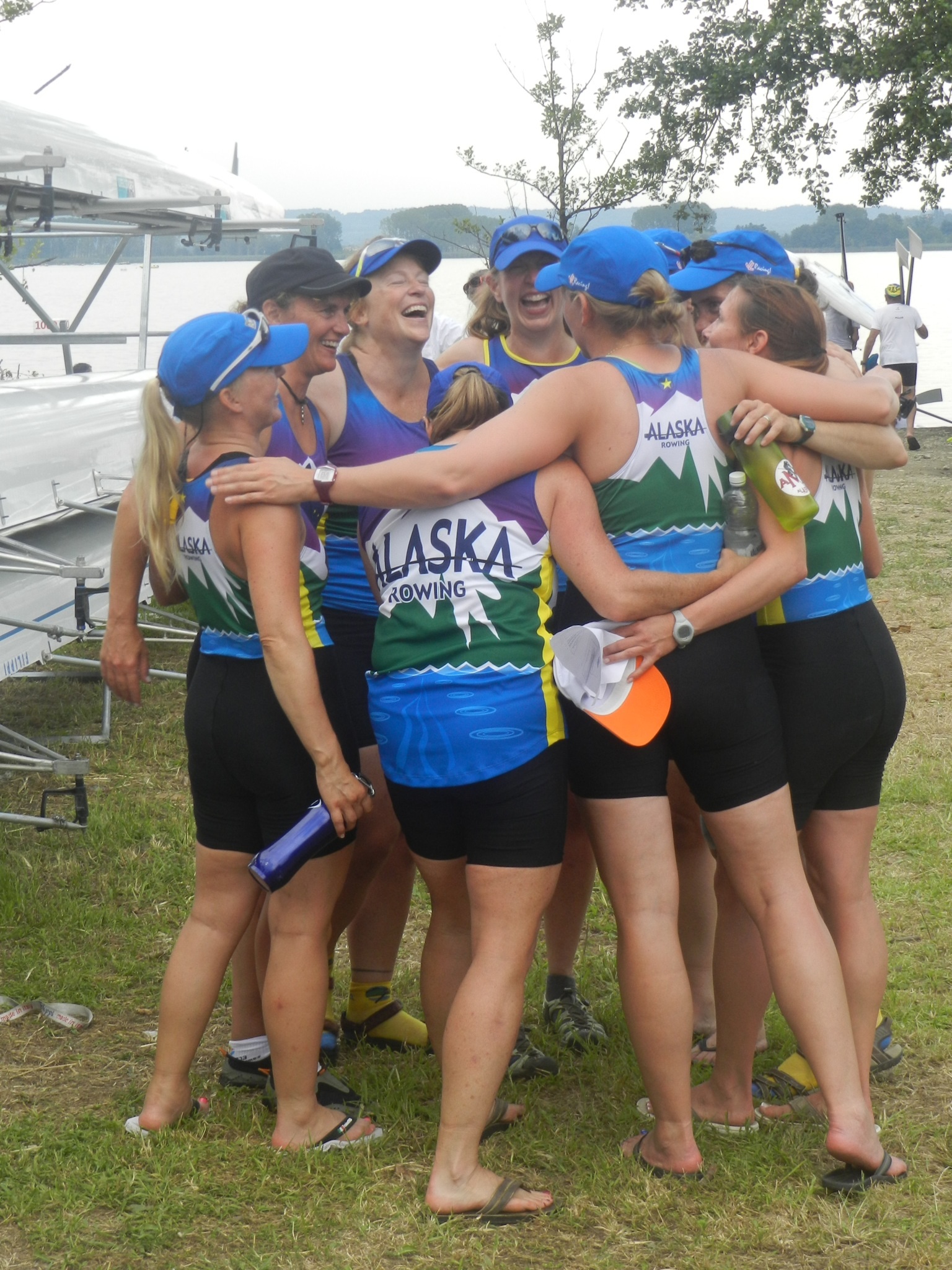 Rowing events in the quadrennial World Masters Games in Torino, Italy, concluded Sunday with a 30-person squad from the Anchorage Rowing Association medaling in six events, the best showing in the Games by Americans.
Anchorage’s medal haul on a 1,000-meter course on Candia Lake outside Torino — site of the 2006 Olympic Winter Games — included two golds and four silvers.
In addition to Anchorage, Homer sculler Karen Hurd, a member of the Kenai Peninsula-based Alaska Midnight Sun Rowing Association, won medals in two more races — a second in women’s doubles with Peninsula rower Margo Bias, and a third in mixed pairs with her husband, Jim Hurd.
Twelve hundred rowers joined the four-day competition, racing in eight separate age categories, from post-college rowers in their late 20s to seniors in their 70s and 80s.
Australia alone sent 700 rowers to Italy and easily won the most medals. But Anchorage may have shown the greatest improvement.
The 15-year-old club, which has to wait for the ice to break on Sand Lake each spring before it can even begin to practice, only won one medal in the 2009 Games held in Sydney and two in the 2005 Games in Edmonton.
In Italy last week Anchorage eclipsed those results on the very first day of competition, advancing both men and women to the finals in several races and winning silver medals in three.
All-woman boats, however, were the only ones that medaled, including a first-ever medal (a silver) in women’s eights, one of the sports glamour events — partly because an eight is the longest and fastest of the seven boats used in rowing and requires the most teamwork.
The Anchorage (age-class “C”) eight included rowers Janet Curran, Marietta Hall, Shelly Andresen, Emma Haddix, Jessica Willis, Erin Bashaw, Anne Blount, Elisa Samuelson and coxswain Natasha Graham. The club is coached by Kern McGinley.
A team from Latvia-Estonia won the gold in the women’s eight event, followed by Anchorage (rowing under the USA banner), Canada, Australia, Russia and Italy.
Curran led ARA overall by winning four medals, including one gold and three silvers. In addition to her second in the eight, her medal boats included silvers in women’s doubles (with Julie Truskowski) and coxed fours (with Haddix, Blount, Bashaw and coxswain Graham).
Her gold came in one of two finals in women’s Class B quads (competition that was divided in half due to a scheduling error by race officials). Joining Curran in the gold medal boat were Truskowski, Hall and Samuelson.
Anchorage’s second gold came in a woman’s pairs race rowed by Haddix and Willis, who sped down the course unopposed due to a lack of entries in what some regard as rowing’s most difficult event.
The final Anchorage silver medal came in a woman’s four without coxswain rowed by Robby Bear, Janeece Higgins, Deb Walker and Sue Sheard.
Overall this year’s World Masters Games saw 18,000 athletes compete in hundreds of events in 30 different sports. The next Games are scheduled to be held in Auckland, New Zealand in 2017.
Crossing the Alps
Posted on August 13, 2013 Leave a Comment
Years ago a good friend gave me a book of poems, reflections and field sketches by the German writer Hermann Hesse, who most college students of my generation knew primarily as the author of Siddhartha. The book was titled Wandering,and it celebrated exactly that.
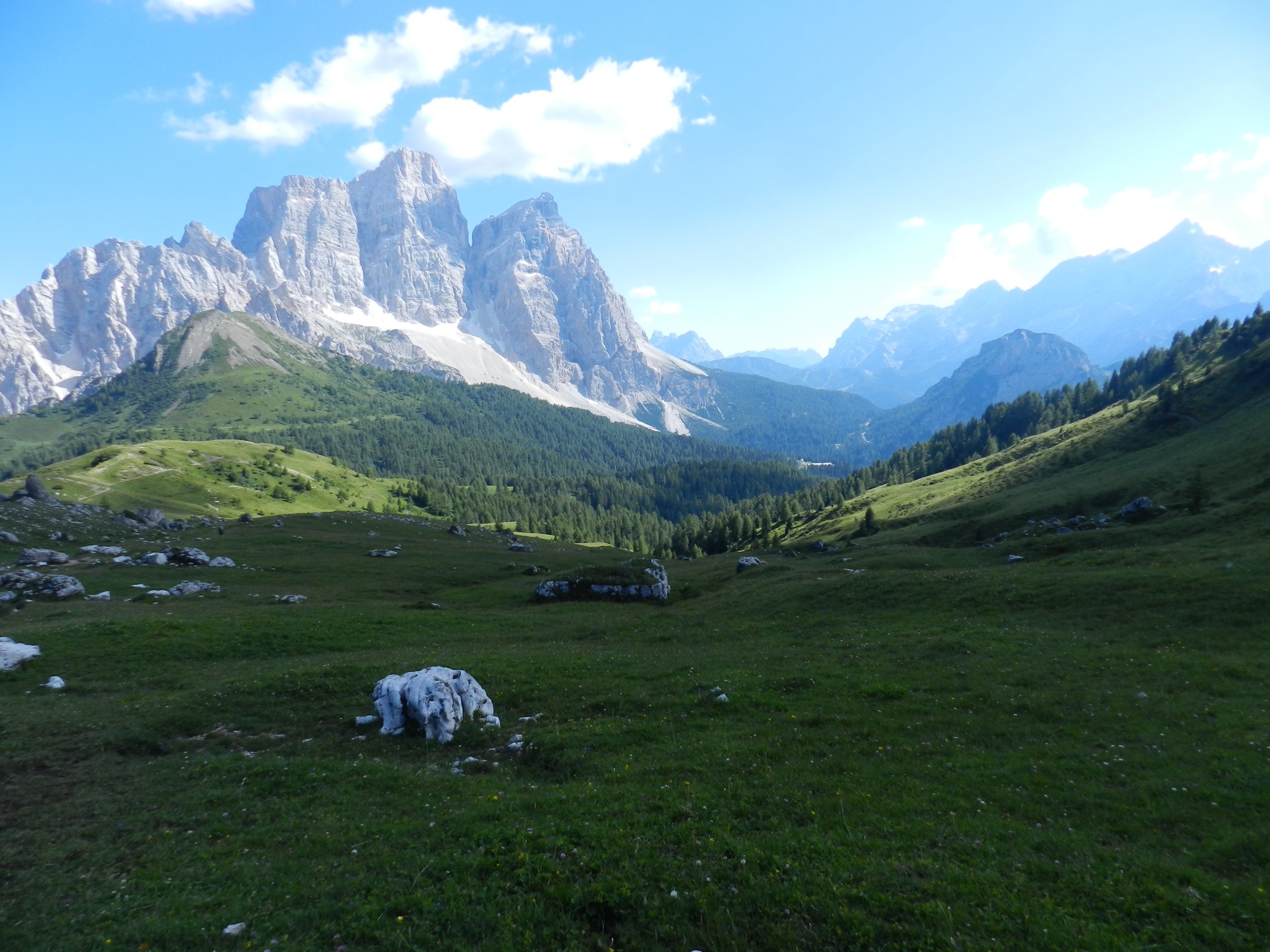
It began in narrative verse with Hesse describing the smells and colors and emotional changes he felt as he crossed the Alps on foot, leaving behind the familiarity of his native Germany to the north for everything that was fragrant and warm and new in the south.
I never intended on my own journey to follow in Hesse’s footsteps or to try to match his experience. But on the other hand, my plane ticket from Alaska to Europe landed me in Munich. And while my solitary trip from there to Italy began on a train — stopping to visit the Bavarian village of Schwangau and the fairyland castle of ill-fated King Ludwig II — it ended on foot in the Alps.
That’s because I had the good sense of saying yes when six fellow rowers, also bound for Torino, invited me to join them beforehand on a hike through the Dolomites near the Austria-Italy border.
After meeting in northern Italy in the small town of Dobbiaco, we bused to a trailhead at Lago di Braes, a handsome alpine lake where we spotted (and I photographed) four shirtless Italian pensioners, rowing a boat in the sun. It seemed like a very good sign.
From there the trail grew steeper and narrower, leaving the picnickers behind. Everything we would take to Italy was on our backs, but we all managed to pack light, since — hiking hut to hut, or rather rifugio to rifugio — we didn’t need gear for camping.
For not much money (about as much as you would pay to stay in a youth hostel) the rifugios also provided dinners and breakfast, showers and beds with lots of cheerful company.
In all we traveled only about 40 kilometers in five days of hiking, mostly up and down. But all of it was stunningly picturesque and new.
We saw stone bunkers and caves where soldiers died in the World War I border battles between Austria and Italy. We saw people from those same nations together hiking and biking today.
We passed fields of grazing cows. We saw a small dark horse that herded sheep, and a free-range pig that for a moment herded us — and almost everywhere heard the Heidi-like clank of cowbells.
We saw marmots and mountain crows and fresh fields of wildflowers, all reminiscent of Alaska.
We got rained on and we dried off. We got sunburned and we healed. We shared hours upon hours of stories.
When we finally reached the end, I decided Hesse was probably right: A little bit of wandering can really sooth the soul.
Then we boarded a train for Torino.
First principles
Posted on August 9, 2013 Leave a Comment
“… Come, my friends,
‘Tis not too late to seek a newer world.”
— Alfred, Lord Tennyson, “Ulysses,” 1833
The first purpose of this public journal (or at least a convenient excuse for it) will be, simply: To report on the collective experience of about three dozen Alaskans, myself included — all members of the Anchorage Rowing Association — as we travel as a team to Italy this summer to compete in the World Masters Games in Torino.
Close on its heels, however, is a larger, more general purpose: To explore the idea of living life to the full just as long as personally possible. Which is more or less what the World Masters Games is all about (as I’ll explain in just a moment).
First, though, let’s introduce the guide and ancient navigator for this blog — the “Ulysses” of the title — known as Odysseus in the epic Greek poem “The Odyssey” (by Homer) and as Ulysses in Latin translations favored by early Italians and latter-day Victorian poets (see Tennyson above).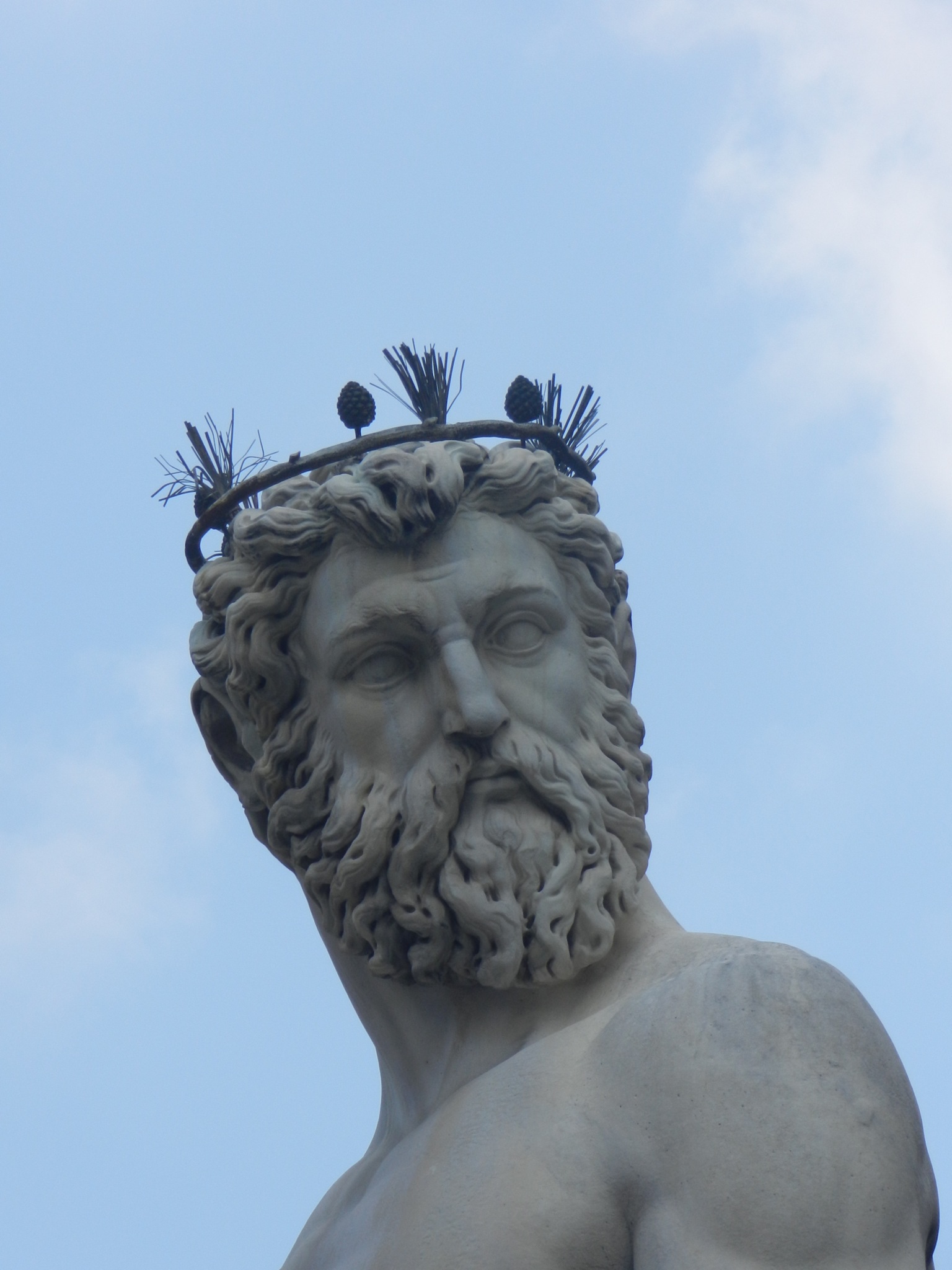
In “The Odyssey,” you’ll recall, Homer sings of the wayward travels of Odysseus, who fought Trojans for ten long years in far-away Troy before spending ten more years trying to sail his way back home. Finally, he succeeded. And that was the end of the story.
Or at least it was until Tennyson came along some 3,000 years later and wrote a poetic sequel to The Odyssey — one in which the eventually-aging king grows tired of domestic life in Ithaca and yearns to travel once more. Ulysses in “Ulysses”:
How dull it is to pause, to make an end,
To rust unburnished, not to shine in use!
As though to breathe were life….
I cannot rest from travel: I will drink
Life to the lees! …
The more he thought about it, in fact, the more the old mariner-king began to warm to the idea of a new sea journey. One in which he and his former crew mates would pursue knowledge “like a sinking star” on the far horizon of some wine-dark sea. They would do so in spite of all the physical challenges for men their age, he tells them, because:
.… Though we are not now that strength which in old days
Moved earth and heaven; that which we are, we are;
One equal temper of heroic hearts,
Made weak by time and fate, but strong in will
To strive, to seek, to find, and not to yield!
So there you have the set-up for … what? Odyssey II? The Return of the Cyclops? Back to Calypso?
I would suggest you at least have a wonderfully eloquent and heartfelt call to live your life purposely — in whichever way you choose — as long as you possibly can.
You may decide to become a doctor in your fifties. Or learn three new languages in your sixties. Or compete athletically in your seventies and eighties (as a certain 80-year-old Australian pole-vaulter did during the last World Masters Games in Sydney).
The Games.
Have you heard of them?
Like the Olympics, World Masters Games competition occurs every four years, bringing together to one city thousands of athletes from around the world competing in about 30 different sports that include hundreds of different events.
But unlike the Olympics — limited to only the most elite athletes in the world competing in the very prime of their lives — Masters competition is open to anyone 27 years of age or older with competitors spanning a broad range of skill levels. In other words, there are no “trials” to limit the field. Pass a basic physical exam, pay a nominal entry fee and you’re in.
Significantly, you only compete against other men or women who are approximately the same age as you are, or, in the case of teams, the same average age. So heading home with an individual or team medal isn’t so wild a dream.
Consequently WMG participation far surpasses that of the Olympic Games. At the last Summer Olympics in London, 10,000 athletes attended the opening ceremonies. In the last World Masters Games in Sydney, Australia, over 28,000 athletes competed.
I happened to be one of them.
I’m George Bryson, a career journalist in his sixties. A 35-year resident of Alaska born and raised in California. A married father of three Alaska-born daughters. A minor wanderer. A lifelong lover of literature, science, nature and sport — who recently found a way to combine all four enthusiasms in one neat package through the art and sport of rowing.
Racing as a rower wasn’t entirely new to me. I’d sculled some (rowing with two oars) in a single and a double during high school, then rowed briefly in a freshman eight (with eight teammates, each rowing with one long “sweep” oar, in a paper-thin, 60-foot-long racing shell) in college.
But more than three decades of newspaper work would then intervene, with its sometimes less-than-healthy deadlines and donuts and coffee. And when, at the end, the newspaper I worked for offered its senior employees a “severance package” — as fiscally challenged papers all across the nation in 2009 did while attempting to trim their payrolls — I left the paper I loved (the “old Anchorage Daily News”) about 30 pounds overweight.
So.
I decided to seize the temporary windfall of my severence pay to award myself a kind of limited athletic scholarship in hopes of getting healthier. I began running and biking and skiing and watching what I ate. In an instant I began feeling both healthier and happier. I also began to row, finding some new, like-minded friends — members of a fledgling Anchorage rowing club — who aspired to some of the very same things.
But that’s a subject for another post. / gfb
 Rowing with Ulysses