Past-imperfect Prague
“God gives us nuts, but doesn’t crack them.”
— Czechoslovakian author Franz Kafka
My guide on a free walking tour of Prague this summer repeated that line to us after pointing out Kafka’s statue in the old Jewish Quarter, then gave everyone a moment to reflect on how that must mean God gives you opportunities, but it’s up to you to succeed.
Perhaps, I thought. Or it could mean that life in Prague is tantalizing … but ultimately wanting. Or it could mean that God just breaks the nuts over your head.
Why would I think that?
Because I’d been taking careful notes during the tour, and what I’d recorded about Czech history so far was nothing less than a thousand years of invasions and occupations and religious cruelty and terrible town-killing plagues. Like when do you get the nuts?
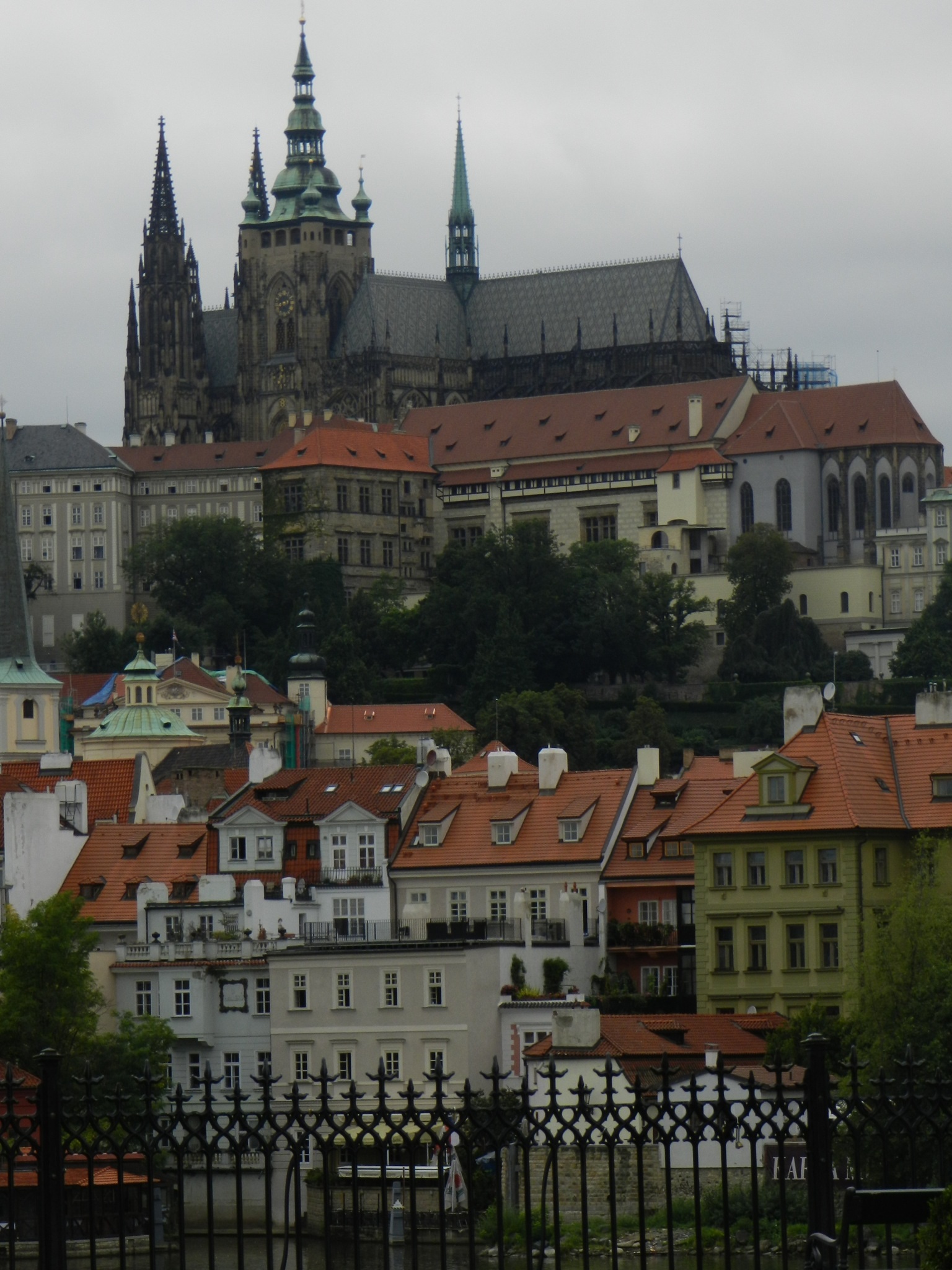
On the other hand, I loved visiting Prague. I liked the people and the place. The old streets, the medieval architecture, the bohemian vibe, the way it lights up at night. I liked the affordable prices and excellent beer.
I loved the fact that a playwright and political dissident — the once imprisoned Vaclav Havel — could ultimately prevail over the former Soviet Union and be elected the first president of the new Czech Republic in a “Velvet Revolution.” I liked the way Havel befriended the Rolling Stones, who paid for floodlights to shine on Prague Castle.
Others must like Prague too. It’s home today to about 1.3 million people, and summer tourists flock there in droves. (According to the Czech Republic tourist council, Prague hosts about 4 million visitors annually, making it the sixth most visited city in Europe.)
On the other hand, there was all that gruesome history.
Where to begin? With the early humans who pushed out the Neanderthals? With the Germanic tribes who pushed out the Celts? With the Slavic tribes who pushed out the Germans? Or about a thousand years ago when a pope in distant Rome declared the whole kingdom of Bohemia (roughly the present-day Czech Republic) as a diocese of the Holy Roman Empire.
Consequently several significant Catholic cathedrals rose in old Prague, which really began to cohere as a town in the 10th century. Its hey-day probably came in the 14th century under King Charles IV, when Prague was the third largest capital in all Europe, trailing only Rome and Constantinople. But it was a qualified hey-day. In the middle of the century the Great Black Plague in Europe killed 25 million people.

Then things got worse after they got better. In the 15th and 16th centuries, scandals in Rome had inspired the reformist message of northern Catholic clerics like Jan Hus and Martin Luther, which led to the founding of the Protestant (for “Protester”) religions. So Northern Europe went Protestant, Southern Europe remained Catholic, and Central Europe was where the two would collide — again and again — in Prague.
It wasn’t long before Christian-on-Christian violence there resulted in public beheadings and defenestrations. (Being “defenestrated” is when they avoid the bother of putting you on trial and simply march you up the tallest tower and throw you out the window.)
Life was even worse if you were Jewish and all the Christians despised you. In Prague that meant that for centuries you were forced to live in a plague-infested swampland next to the Vltava River and nowhere else. And as the population there grew, there was less available land in the Jewish quarter in which to live — let alone be buried in. Because when you died, you could only be buried in the tiny Jewish cemetery and after a while there wasn’t any room left.
So the Jews of Prague would carefully detach all the tombstones from the ground (leaving the bodies in place), bring in a new layer of soil, stick the old tombstones back on top where they were and start a new layer of burials, with the combined tombstones crowding ever closer and closer together. And so it went for centuries. According to three sources cited in Wikipedia, there were eventually 12 layers of Jewish dead buried in the Prague cemetery, possibly 100,000 to 200,000 bodies in all. As Petra, our tour guide, pointed out, the ground there is now higher than the perimeter retaining wall.
Reforms in the Holy Roman Empire that eventually came in the 18th century gave Jews in Europe more freedom, and for a while their lives improved. But the cemetery would live on in infamy — as an anti-Semitic legend suddenly emerged around the turn of the 20th century claiming that Zionist Jews were meeting there secretly at night to hatch a plan to rule the world. This imagined Zionist conspiracy in the Prague cemetery was one of the reasons to purge Jews from all of Europe that would later be cited by Adolph Hitler.

But that’s getting ahead of our history. Here’s the rest in a nutshell. Beginning in the 16th century and lasting for the next 400 years the people in Prague were ruled by people in Austria who spoke a different language (the House of Habsburg dynasty, which for a while was synonymous with the Holy Roman Empire). Along the way religious infighting continued (see “Thirty Years War”).
World War I came and went and that ended the Habsburg rule in Prague and created the new nation of Czechoslovakia, which combined the people of Bohemia and Moravia. That happy state lasted for about 20 years — until Hitler invaded Czechoslavakia in 1939 and World War II began. During the war, a majority of the Jews in Prague were deported and executed by the Nazis. After the war, the Soviets moved in and, well, you probably know the rest of the story: Twenty years of worsening conditions under the Communists. The “Prague Spring” of 1968 (and the Soviet crack-down that crushed it). The Gorbachev/Glasnost era in 1988 (and the collapse of the Soviet Union that followed). The Velvet Divorce of 1993 (dividing Czechoslovakia in two and creating the new Czech Republic).
All of which brought the story full-circle back to my tour guide, Petra. She was born in Prague in 1980 and lived nine years under the foreign auspices of the Communists.
“Everything was grey then,” she told me. “There was no food. There was no freedom of speech or religion. There was no travel abroad. You were forced to spy on your neighbors.”
Life in Prague now is immeasurably better, Petra said. But after a thousand years of foreign occupation, her neighbors — indeed all Czechs — remain understandably a bit cautious and wary. They’re staring into the light of a brand-new day where — who knows? — maybe they’ll find some nuts.
 Rowing with Ulysses