Garden of brains and bones
Let’s give the French their due.
Before English naturalists and American geneticists began receiving so much credit for break-through discoveries in the Life Sciences — from Darwin to DNA — you first had to collect, compare and categorize as many species as possible.
And for that you had to travel to Paris.
More specifically, you had to visit the remarkable collections of late 18th and early 19th century French zoologist Georges Couvier, an expert on everything from beetle skeletons to fish fossils to wombat brains.
And you can see them still if you find your way — as I just did — to the Jardin des Plantes (the spacious botanical garden in central Paris) wherein you’ll find the various galleries of the world renown Museum d’ Histoire Naturelle.
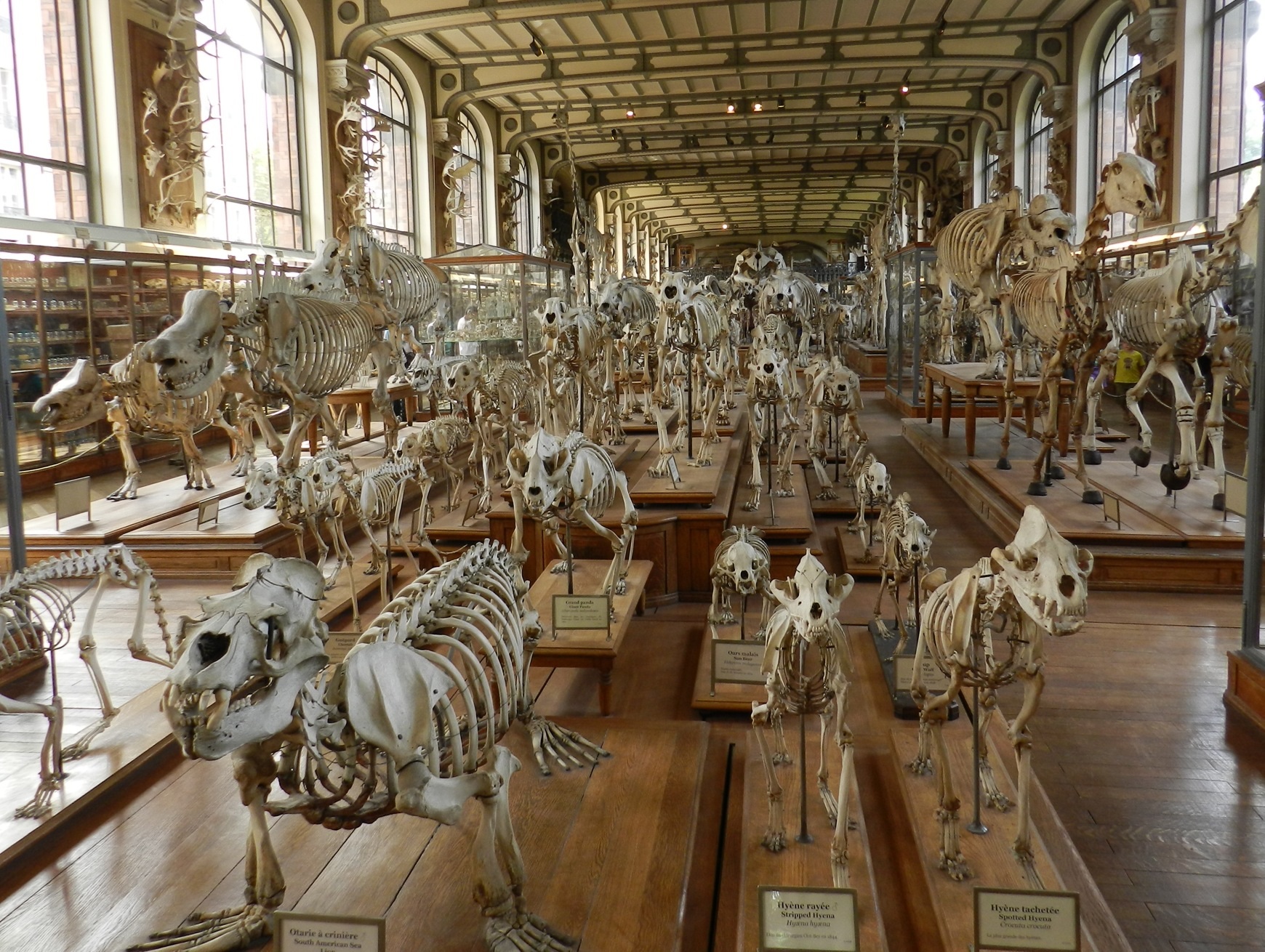
Today the French natural history museum (actually several museums) houses a breath-taking total of 65 million specimens, including the largest paleontological collection in the world, thanks largely to Couvier, who’s widely considered the father of paleontology.
But just by chance I happened first into the stately Paleontology and Comparative Anatomy Gallery, where you can stare into the jaw of an ancient 30-foot-long crocodile (see slide show below) or compare the brain size of hundreds of tiny mammals.
I’ve visited spectacular natural history exhibits before at the Smithsonian and the British Museum of Natural History, but something about the Galerie was more fascinating, like peeking into the private chambers of the world’s greatest naturalists back when Darwin was only a boy.
According to the museum catalogue, however, its collection is anything but musty or dead to science — given the capability today of extracting DNA from ancient specimens to trace their genetic and evolutionary pedigrees. After sleeping for a century or so, it’s now a treasure trove of new scientific research.
I also had a chance to visit — across the botanical garden — the newer and much more avant-garde Grande Galerie de L’Evolution, with it’s Noah’s Arc procession of large mammals and interactive media. Though it’s amusing (if not agravating) to find no English translations at all. O the French!
I was also getting hungry. So before catching my evening train to Nice, I took a stroll along the Seine to find a place to eat. After slowing down as I passed all the book stalls and street musicians, I decided just to picnic on the bank and watch the setting sun. That and the great parade of humanity that passed by. The most fascinating exhibit of all.
 Rowing with Ulysses