Siren Songs
“Then, for coffee, I pulled up a chair in the smoke-and-coffee-stained Café Hawelka, where intellectuals like Leon Trotsky once stewed. The decor was circa-1900. Old man Hawelka himself was snoozing on a Biedermeier chair near the bar. His granddad could well have served a Mélange (as they would have called their cappuccino) to Trotsky, Hitler, Stalin, Klimt, or Freud — all of whom were rattling around Vienna when the chair I was sitting on was made …”
— American travel writer Rick Steves, from “Sunday Morning, Vienna Style”
Turns out I was rattling around Vienna this past weekend too, my first venture ever into what used to be considered — for about 600 years — the most powerful city in eastern Europe. Hometown of the prolific Habsburg family, rulers of the once-sprawling Austro-Hungarian empire.
Maybe a little bit too sprawling. Over-reach by the Habsburgs into places where men and women had little in common in speech or custom with their Austrian overlords was one of the chief causes of World War I, which ended the Habsburg rule once and for all.
(For the record, though, a more complete answer to the Trivia Game question of who started WWI goes like this: (1) A teenage Serb nationalist in Sarajevo assassinates his future king — a Habsburg — Archduke Franz Ferdinand. (2) One month later Austria declares war on Serbia. (3) A tangled web of international alliances and nationalist ambitions prompts Russia, Germany, France, England and Italy all to join the war, too, on one side or the other.)
In any event, it wasn’t over in a week as advertised and it didn’t go well for anybody. Certainly not the Habsburgs.
I’d never met one until this week, but it’s pretty hard to miss the former Empress Marie-Theresa, sitting there sensibly enough in the center of Maria-Theresien Platz. I liked her immediately. Approaching her statue from behind, I noticed the way she filled the throne from side to side (see slide show below). And from the front, I noticed too that she held in her left hand — just as Wikipedia said she would — a rolled-up copy of the “Pragmatic Sanction of 1713,” which for the very first time gave women the right to rule the empire if their parents failed to produce a male heir (more in the interest of keeping the monarchy in the family than any sort of progressive notion about women’s rights). Well, that triggered another European war right there, one that even spilled over to King George’s America. But the Habsburgs ultimately prevailed, and during her 40-year rule Maria bore 16 children, nearly all of whom she married off to become royalty of the surrounding nations of Europe. Pragmatic indeed!
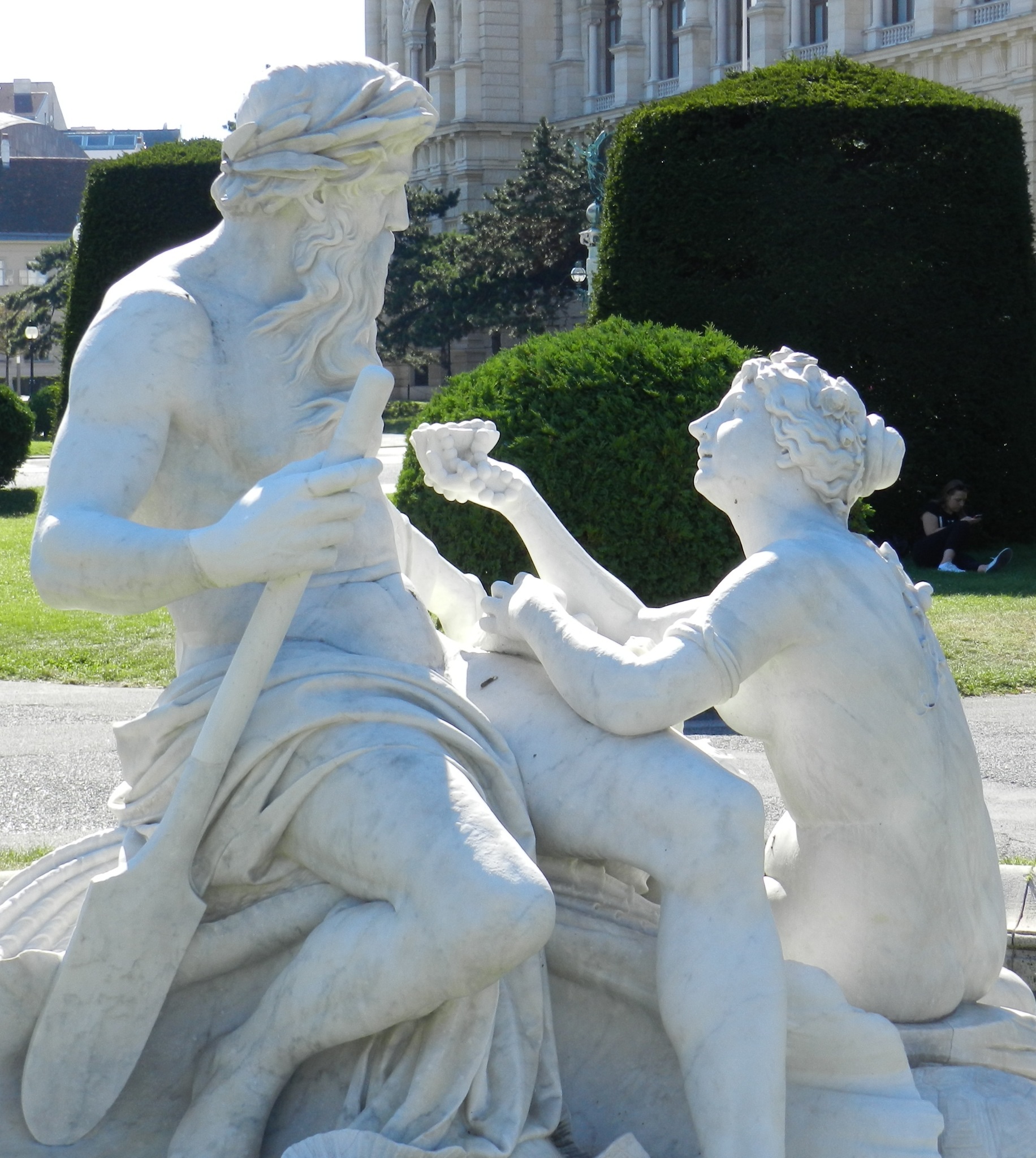
Maria’s statue gazed off in the direction of her family’s estate — a long, curving palace that could have inspired Karl Marx to write Das Kapital had he ever had a chance to visit. But I was gazing off at a fountain, where a nearby classic-Greek statue of a bearded mariner with a short paddle rested in the center of a fountain (see image above).
I tried but could not find any information about who the statue represented or what it celebrated. But I immediately thought: Ulysses! And I think that the sculptor caught him at that very moment in which the goddess Calypso was imploring him to forget about his wife back in Ithaca and remain on her island a while longer.
That kind of thing happened to Ulysses a lot. Something attractive and seemingly easy was always trying to entice him in the wrong direction. Like the song of the Sirens. Or the siren song of war.
I had an opportunity to think about that a little bit more as I left the square and passed by Vienna’s opera house, where the nearby “Monument Against War and Fascism” stands — on the very spot, Steves says, where a couple of hundred people hiding in a cellar during World War II were buried alive when the bombs fell. The statuary there include stark images of the two world wars with an unblinking look at Austria’s role in them. I took some pictures of the monument (again, see the slide show below), but you also might want to learn more about it by following this link: http://www.ricksteves.com/plan/destinations/austria/viennamonument.htm
One last story from Vienna: I was just passing by a monument to a perpetually young Wolfgang Amadeus Mozart when I was approached by a man selling tickets to a concert. That very night, he said, a Konzerte featuring some of the masterworks of Mozart and Johann and Richard Strauss would be performed by the internationally reknown Schoenbrunn Castle Orchestra of Vienna and a wonderful soprano — at the Schoenbrunn Castle, where Mozart himself performed before the king of Austria at something like the age of 5. Would I like to buy a ticket?
Part of me thought: This is my last night in Vienna. I will probably never ever be here again in this lifetime. I should go…. And yet another part of me thought: Wait a second. It’s not cheap. And wouldn’t that be just like the Sirens to find someone vulnerable like me and encourage him in a direction he shouldn’t ought to go? Well, maybe so, I finally concluded. But it wouldn’t be the first time. So I took the ticket as I handed the man some money, then continued on my way.
 Rowing with Ulysses